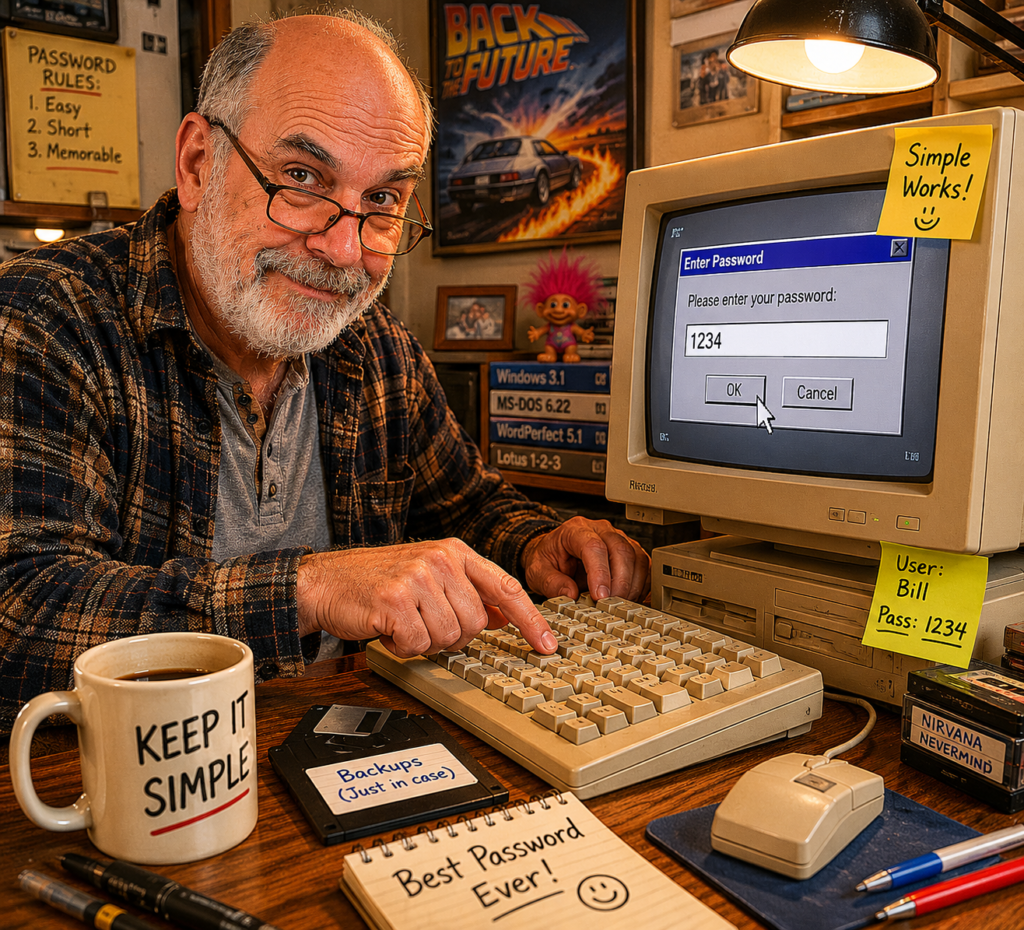
Ah, the good old times. Remember when your dog’s name or your birthday alone could unlock the digital world for you? Well, if you do, congratulations! You’re old in Internet years, just like me. Gone are the days when Spot0920 would magically open your universe of kitten videos and viral song challenges. Welcome to the laughably ridiculous carnival of modern password creation.
It’s the 21st century and password creation is no longer a simple affair—it’s a masochistic game designed to test your memory, your typing speed, and apparently, your mental stability. It speaks volumes that the folks who design websites today are confident that we can remember a cryptologic puzzle but can’t recall whether we ate breakfast this morning.
Here’s the run-of-the-mill requirements for a password nowadays: it must be 14 characters long, have a capital letter from the Esperanto alphabet, contain a special character from a language you don’t speak, a Fibonacci sequence number, a symbol that’s not on your keyboard, the first prime number that popped in your head, ancient hieroglyphics, a snippet of a long-lost language, and your first-born child’s future theoretical university ID. It’s like they’ve mistaken us for Alan Turing cracking the Enigma Code, not Joe Bloggs trying to access his online banking.
And hey, if by some divine intervention, you manage to concoct a password that fulfills these outrageous conditions and learn to reproduce it accurately on demand, don’t get too comfortable! Remember, you’ve made a cardinal sin: using a password that happens to be one you’ve used before in your past thousand lives. Internet law dictates that this is unacceptable.
“Cannot reuse a previous password”. Ah, those despised words. Dear brother, I don’t even remember what I had for dinner last night, you expect me to remember a password that has more diversity than a United Nations summit?
Indeed, welcome to the absurdity of our hyper-connected era: a world where people can remember every word of a three-season TV show but cannot remember their own email password.
What’s next? Will future passwords require a strand of unicorn hair and the atomic weight of krypton? Will we need to solve the Riemann Hypothesis before we can access Twitter?
Perhaps we’re not far from a metamorphosis where we’ll have passwords as fingerprint-replaced avatars. In the meantime, let’s relish our existence in this insane password-centred universe. After all, recalling these peculiar codes keeps the old grey matter ticking over. What a time to be alive.
Until then, I bid you adieu, and may your password resets be rare and your security questions simple.