A Magnet Sticks to Your Pan. Why Won’t the Induction Cooktop Heat It?
The magnet test is a useful clue, not a compatibility guarantee. The pan’s base size, construction and position can still leave dinner sitting there, cold and technically magnetic.
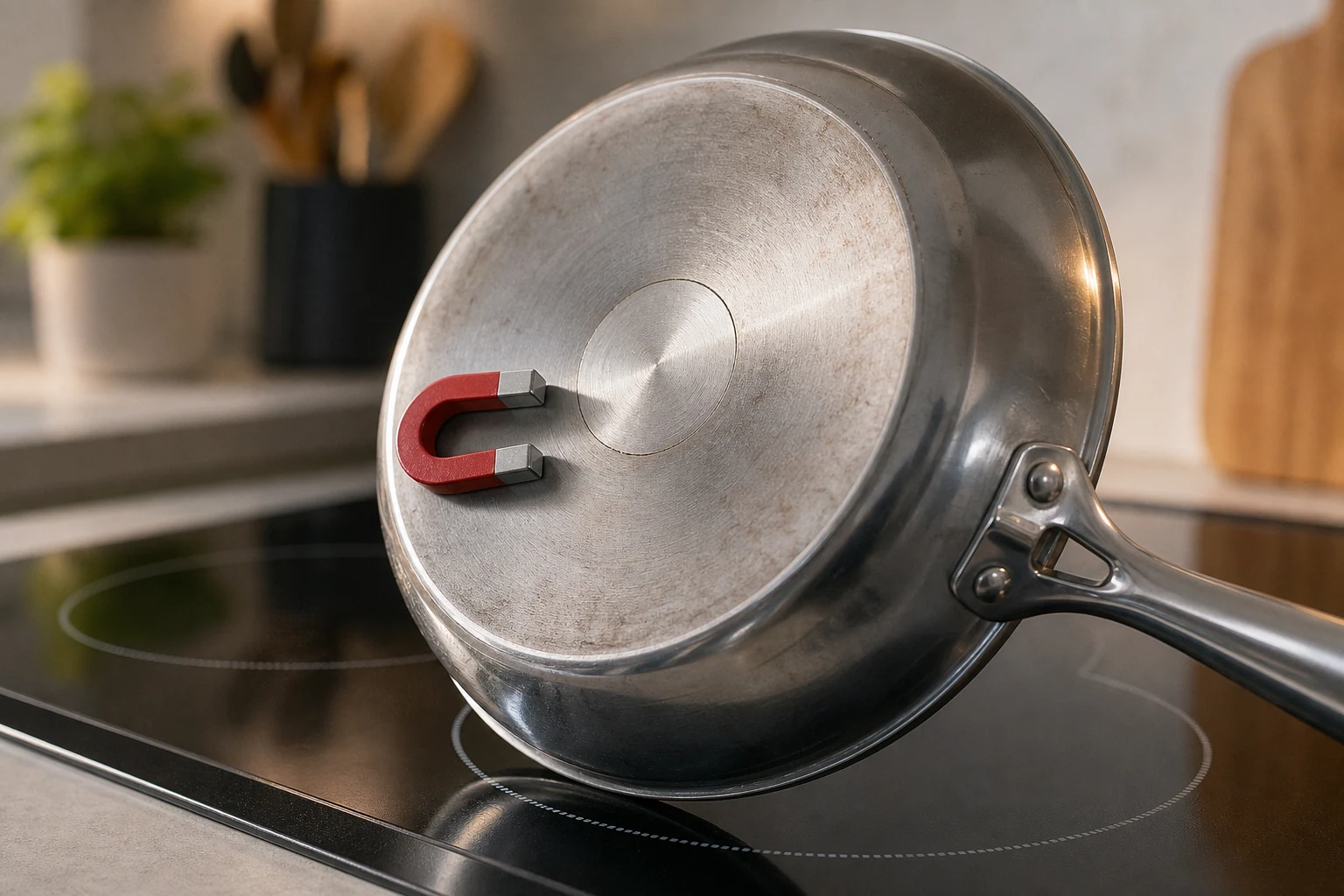
A magnet sticking to a pan’s bottom doesn’t guarantee that an induction cooktop will recognize or heat it properly. The cooktop also needs a suitable magnetic base of sufficient size, positioned correctly over the cooking zone. A small magnetic patch can pass the fridge-magnet audition and still fail to get you dinner.
If your cooktop flashes a pan symbol, reports no cookware or refuses to heat, check the underside of the pan and the cooktop’s minimum pan requirements before assuming either one is broken.
What the magnet test actually tells you
Induction cooking relies on a magnetic field interacting with suitable cookware. Cast iron and many magnetic stainless-steel pans work. Plain aluminum, copper and glass generally don’t, unless the cookware includes a suitable induction-compatible base.
Stainless steel is where the labeling gets particularly helpful, by which I mean sometimes it isn’t. Not every stainless-steel pan is magnetic.
With the pan cool, place a magnet against the underside of the base. Testing the handle or side tells you about the handle or side. Neither is where you’re trying to fry an egg.
A firm attraction across the cooking base is a better sign than a weak attraction in one small spot. But the magnet can’t tell you whether your particular cooktop will detect that base reliably.
The pan may be wide enough. Its magnetic bottom may not be.
A pan’s advertised diameter often describes its width at the top, not the magnetic area underneath. A broad frying pan can have a noticeably smaller induction disk attached to its bottom.
That matters because induction cooking zones have cookware-detection limits. If the magnetic base is too small for the selected zone, the cooktop may behave as though there’s no pan there at all.
Check your cooktop’s manual for minimum cookware-base sizes and placement instructions. Don’t assume the circle printed on the glass is a complete explanation. Apparently the circle needed supporting documentation.
What to check before replacing anything
- Look up the exact pan. Check its packaging, markings or manufacturer’s listing for induction compatibility. A coil-like symbol commonly indicates it, but an explicit compatibility statement is clearer.
- Check the magnetic base, not just the rim. Compare the base dimensions with the requirements for the cooking zone you’re using.
- Center the pan. Unless your cooktop’s instructions say otherwise, place it centrally on the marked zone. Use the designated placement rules for flexible or linked zones.
- Inspect the bottom. A badly warped base or damaged bonded disk is a cookware problem, not something to solve with repeated button pressing.
- Read the displayed warning. A flashing indicator might mean missing cookware, but error symbols vary. The manual can distinguish that from a control lock or another fault.
A simple comparison can narrow it down
If you already have a pan that works on this cooktop, try it on the same zone, following the normal operating instructions. For a heating check, use some water rather than heating an empty pan, and stay nearby.
If the known-working pan heats and the questionable one doesn’t, cookware compatibility or placement becomes the likely explanation. If neither works, check the settings and troubleshooting instructions before buying another pan.
If the manual permits the questionable pan’s base size on a smaller zone, try that zone. This is a troubleshooting suggestion, not a tested fix for your particular pan and cooktop. It won’t make unsuitable cookware suitable.
What to check before buying a replacement
Look for an explicit induction-compatible designation, a suitable base size and a return policy that lets you resolve compatibility problems. Check that policy before doing a heating test.
The magnet is useful for screening cookware. It just doesn’t get the final vote. Your cooktop has reserved that privilege for itself.
The conversation
Have a thought? Add it below. Comments are reviewed before they appear.